

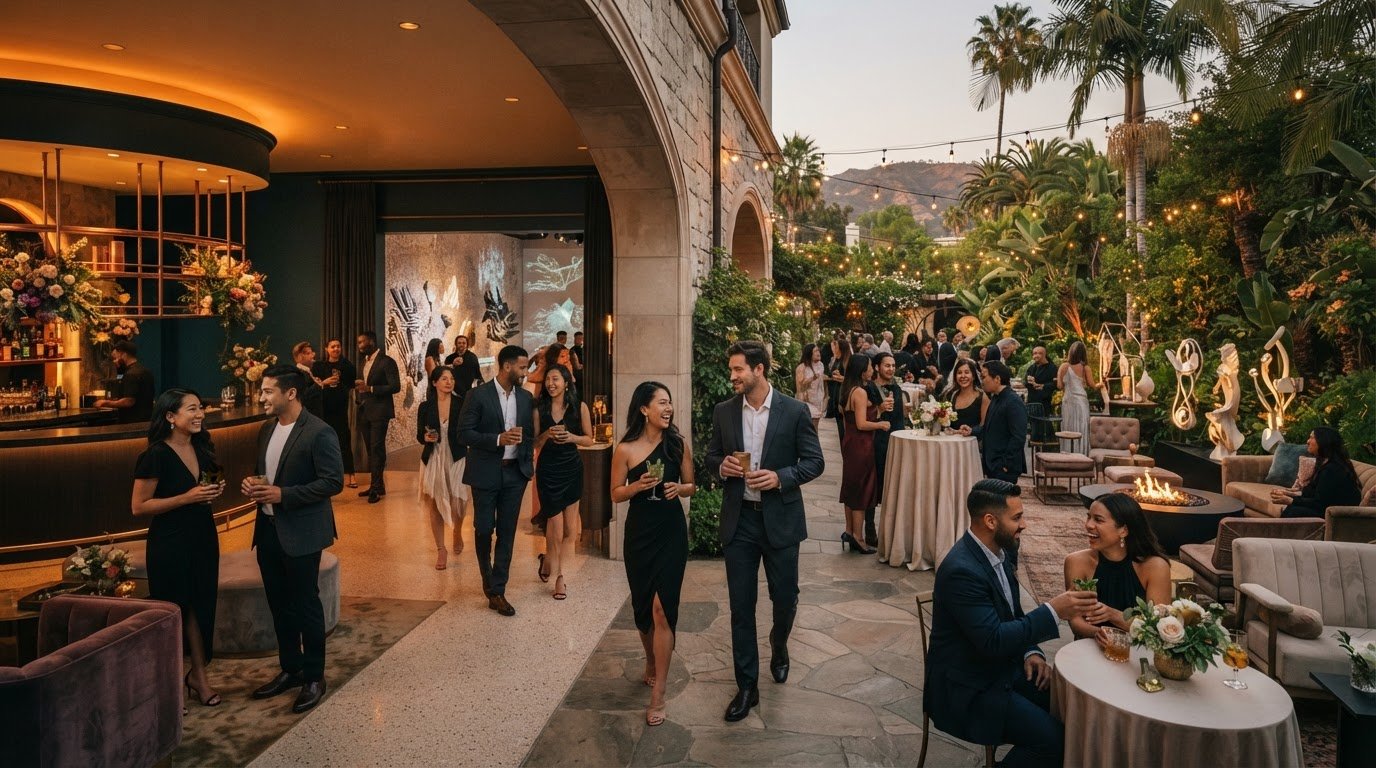
What makes a brand event memorable is often more than the display. It’s the route guests take through the experience. When comparing experiential marketing spaces Hollywood has to offer, look for a setting that supports your campaign story and makes it easy for guests to explore, connect, and take part.
A venue’s visual appeal matters, but your concept also needs room to unfold, clear transitions between moments, and practical details that work behind the scenes. Casita Hollywood offers exclusive use of its entire venue, with connected indoor and outdoor areas planners can consider when shaping an event around an approved brand concept.
This guide explains how to match a Hollywood venue to your brand story and audience, plan a guest journey that encourages participation, and identify what to confirm with the venue and production team before committing. Use it to assess creative fit alongside logistics, technical needs, and event planning requirements.
Key Takeaways
- Evaluate experiential marketing spaces Hollywood planners are considering by how well the setting supports the campaign story, audience, and intended interactions.
- Map the guest journey from arrival to departure, assigning space to welcome, discovery, participation, and conversation.
- Compare venues using consistent criteria, including privacy, layout flexibility, guest flow, location, and confirmed production requirements.
- Before booking, share your concept and preliminary layout with the venue, then verify technical capabilities, capacity, accessibility, and event policies.
- Consider whether exclusive use of an entire venue and access to indoor and outdoor areas suit the experience you want to create.
What Makes an Experiential Marketing Space in Hollywood Effective?
A memorable brand event depends on more than what guests see. It also depends on how the setting invites them to notice, explore, and engage with the story. For experiential marketing spaces Hollywood planners are evaluating, effectiveness comes from the fit between the venue, the audience, and the intended experience. The setting can support that experience, but it can’t guarantee how guests will respond.
An experiential venue is a physical setting chosen for how its layout can support audience engagement, while a standard event rental may simply provide a place to gather. The distinction is in the opportunity, not a prescribed format. Guests might encounter a reveal, move through a sequence of brand moments, or have room to talk and participate. The venue provides the setting; the campaign team develops the strategy and content, and the production team plans how to deliver them.
How is an experiential space different from a standard event venue?
Think of the layout as part of the storytelling. An arrival area can create a considered first impression, an open route can guide discovery, and a gathering point can make conversation feel natural. These choices can reinforce campaign messaging without dictating a single creative approach. The principles of engagement marketing also center on meaningful interactions, but the venue alone doesn’t create them. The concept, content, and production plan bring the experience to life.
Look beyond photographs when comparing options. Ask whether the space can accommodate the planned sequence of guest moments, where people may pause, and how they’ll move between areas. Confirm practical requirements with the venue and production team rather than assuming that a visual impression proves the space is suitable.
Which brand events can use an experiential venue in Hollywood?
Product reveals, press gatherings, pop-ups, and customer events can all benefit from a setting selected to support participation. A product reveal might need a clear focal point, a press gathering may prioritize conversation, and a pop-up could call for room to explore. These are planning considerations, not guarantees about any venue. Suitability depends on the audience, creative concept, and verified capabilities, including details to confirm before booking.
Casita Hollywood offers private, exclusive use of its complete venue in Hollywood, with connected indoor and outdoor areas. Planners can consider these distinct spaces when designing event flow around an approved concept. The venue doesn’t replace a campaign strategy or production team. Define the intended guest experience first, then assess whether the setting can support it.
Design the Guest Journey Around Your Hollywood Activation Space
A guest journey turns an event layout into a sequence with purpose. The guest journey connects campaign intent to event layout by giving each step, from arrival to departure, a place and a reason. As you compare experiential marketing spaces Hollywood offers, picture how attendees will move through the setting, what they’ll encounter, and where they’ll have room to connect. This kind of planning supports the goals of experiential marketing, where the live interaction is central to the brand experience.
How should arrival and first impressions support the brand story?
Start by deciding what guests should notice first. Then consider how the arrival experience can introduce that idea while making it clear where to go. A defined welcome point, an easy-to-follow route, and enough space to get oriented can help the opening feel considered rather than hurried. Confirm arrival arrangements and relevant venue logistics directly with the venue before finalizing the plan.
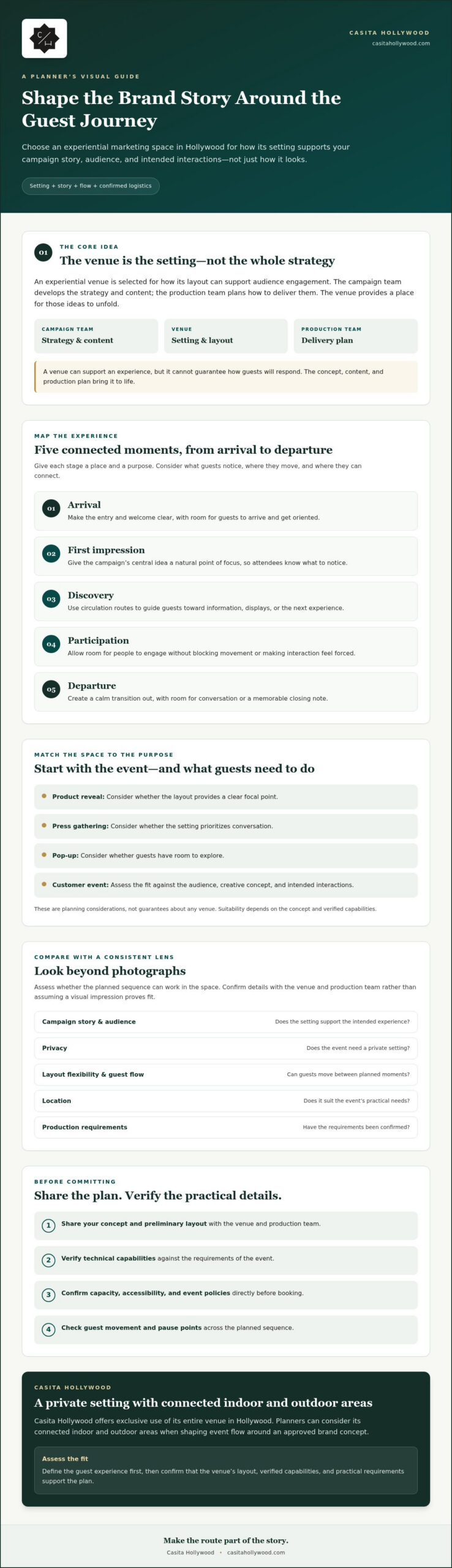
From there, shape the journey in five connected moments:
- Arrival: Make the entry and welcome clear, with room for guests to arrive and get oriented.
- First impression: Give the campaign’s central idea a natural point of focus, so attendees know what to notice.
- Discovery: Use circulation routes to lead guests toward information, displays, or the next experience.
- Participation: Allow room for people to engage without blocking movement or making the interaction feel forced.
- Departure: Create a calm transition out, with an opportunity for conversation or a memorable closing note.
How can indoor and outdoor areas create distinct event moments?
Connected indoor and outdoor areas can support different moods within one event when each has a clear role. An indoor space might anchor a welcome or focused presentation, while an outdoor area could offer room for discovery or relaxed conversation. These are design possibilities, not assumptions about a venue’s specific capabilities. Confirm details that matter to your plan, including access between areas and any technical or accessibility requirements.
Give transitions as much thought as the spaces themselves. Help guests understand where to go next through the sequence of activities, clear wayfinding, or cues within the campaign design. If attendees move between areas, consider how that shift affects flow and whether the next moment feels like a natural continuation. For more planning ideas, explore this indoor-outdoor venue planning guide.
Casita Hollywood’s connected indoor and outdoor areas give planners different spaces to consider when mapping the guest journey. Review the Casita Hollywood venue details and confirm your event’s specific requirements with the venue before committing.
Compare Experiential Marketing Spaces in Hollywood by Campaign Fit
A beautiful space can set a mood, but appearance alone won’t tell you whether it can support your activation. Compare experiential marketing spaces Hollywood planners are considering against the event’s essential needs first, then weigh creative preferences. This helps keep a striking backdrop from overshadowing practical questions about privacy, movement, and production.
Use the same framework for each potential venue. Mark each item as a must-have or a preference, and record what has been confirmed rather than relying on photographs or assumptions.
| Factor | Must-have to verify | Creative preference |
|---|---|---|
| Privacy | Does the exclusive-use arrangement cover the areas your event needs? | Would private use support the atmosphere or content you want? |
| Layout flexibility | Can the existing spaces support your planned activities without unapproved changes? | Can the layout express the campaign in a distinctive way? |
| Guest flow | Can attendees move between key moments without unclear routes or bottlenecks? | Could the sequence create a sense of discovery? |
| Location | Does the location work for your intended audience and arrival plan? | Does its setting add character to the brand story? |
| Production requirements | Are the needed technical capabilities, access details, and event rules confirmed? | Can the production plan deliver the look and feel you envision? |
What should a Hollywood venue walkthrough help you verify?
Walk the route as an attendee would, from arrival through the planned experience and departure. Notice where guests might pause, cross paths, or be unsure where to go next. Ask which indoor and outdoor areas are included in the exclusive-use arrangement, and verify accessibility, operating details, and venue rules directly with the venue. A site visit lets you test the plan against the actual space, not just admire it.
How do privacy and flexibility affect brand activations?
Exclusive use may suit an event that needs a more private atmosphere or a defined guest experience, but its value depends on the audience and concept. Casita Hollywood offers exclusive use of its complete venue. Confirm which areas and conditions apply to your event. Flexibility also has limits: don’t assume walls, fixtures, or structural elements can be changed. Ask what the venue permits, then align the creative plan with those confirmed boundaries. If privacy is central to your brief, read this guide to exclusive venue rental in Los Angeles.
Share the event plan with the venue and production team before committing to suppliers. Confirm that the venue’s technical capabilities suit the specific activities and setup you’re proposing. The right space is the one that works for the experience in practice, not simply the one that looks compelling at first glance.
Plan Production and Guest Logistics Before Booking a Hollywood Space
A strong concept needs a practical plan behind it. Before committing to a venue or suppliers, share your event idea and a preliminary layout with the venue. This can surface questions about guest movement and technical needs while there’s still time to adjust the plan. For planners considering experiential marketing spaces Hollywood offers, clear answers matter as much as creative potential.
Use this pre-booking checklist to guide the conversation:
- Event format: Describe the planned activities, audience, and how guests are expected to take part.
- Timeline: Map arrival, event moments, departure, supplier access, setup, and breakdown. Confirm available setup windows directly.
- Guest flow: Share the intended route, gathering points, transitions, and any moments likely to draw a crowd.
- Production: List sound, power, lighting, connectivity, and other technical needs, then ask which specifications are confirmed.
- Operations: Ask about load-in access, accessibility, weather contingencies for outdoor plans, and applicable venue rules.
- Responsibilities: Clarify what the venue rental includes and what requires outside suppliers, equipment, or staffing.
Which production questions should planners ask before confirming a venue?
Ask specific questions: Which technical capabilities have been verified? How will suppliers access the space? What setup and breakdown windows are available? Could any restrictions affect the concept? Don’t assume equipment, staffing, or production support is provided. Request written clarity on inclusions and responsibilities, and have the production team assess the plan against confirmed venue details before booking suppliers.
Check rules and approvals with the same care. Applicable permits, noise limits, and operating requirements can depend on the event and its jurisdiction. Confirm what applies with the venue and relevant authorities rather than treating a general checklist as event-specific guidance. In Los Angeles, the appropriate process may vary by jurisdiction, so verify requirements before finalizing the plan.
How can teams make a Hollywood activation easier for guests?
Thoughtful logistics are part of hospitality. Give guests clear invitation details and arrival instructions, then use legible signage and consistent cues to guide transitions between event moments. Consider how your audience may travel to the location and plan communications accordingly, without assuming parking or arrival options that haven’t been verified.
Coordinate the run of show with the venue and the production partners responsible for delivery. Confirm who handles each transition, when suppliers need access, and how the team will respond if weather affects an outdoor element. If you’re assessing a private Hollywood setting for your plan, explore Casita Hollywood as a venue option.
Explore Casita Hollywood as a Private Setting for Brand Experiences
In the heart of Hollywood, Los Angeles, Casita Hollywood offers exclusive use of its complete venue for one event party at a time. Its connected indoor and outdoor areas give planners distinct spaces to consider as they shape event flow, from a focused brand moment inside to a change of atmosphere outdoors. The setting can provide a private backdrop for an approved concept, while campaign strategy and production remain with the event team.
When might an exclusive-use Hollywood venue suit a brand event?
Exclusive use may be worth considering when an experience calls for one event party to use the complete property. It gives planners the opportunity to map guest movement across the setting without sharing those areas with another event party. Whether that suits a press gathering, customer event, or another activation depends on the audience, campaign concept, and practical requirements. No single format fits every brand.
As you compare experiential marketing spaces Hollywood has to offer, weigh privacy alongside layout, guest flow, and the event’s specific needs. Confirm directly with the venue which areas are included, along with relevant policies, technical requirements, and availability. For broader criteria to guide your search, see this Los Angeles brand activation venue guide.
What should you share when exploring venue fit?
A concise event brief makes an initial venue conversation more useful. Prepare the event purpose, estimated guest count, preferred date, and an initial run of show. Include the planned guest journey and explain how you hope to use indoor and outdoor areas. If the concept includes installations, sound, power, or other technical needs, describe them as requests for feasibility confirmation, not assumed venue provisions.
Before committing, confirm whether the venue can accommodate the proposed plan and ask about policies or details that could affect the event. Capacity, accessibility, technical capabilities, and operating requirements all need direct verification. Confirm availability with the venue rather than assuming it from a listing or article.
Preparation makes it easier to assess whether the setting suits your campaign without asking the venue to guess at your vision. Explore Casita Hollywood’s venue and share your event requirements to begin considering fit.
Shape Your Brand Event Around the Right Hollywood Setting
A compelling activation begins with a venue that supports the campaign story and the way guests will experience it. Look beyond appearance: map the journey from arrival through participation, then compare spaces against essential needs such as guest flow, privacy, and confirmed technical requirements. Clear conversations with the venue and production team can surface practical questions before you commit.
Casita Hollywood offers exclusive use of its complete property for a single event party, with connected indoor and outdoor spaces in Hollywood, Los Angeles. These areas give planners different settings to consider as they shape event flow. Confirm specific event fit, capabilities, policies, and availability directly with the venue.
The right choice is the one that lets your concept feel intentional from the first welcome to the final moment. Explore Casita Hollywood for your brand event and share your plans to discuss venue fit.
Frequently Asked Questions
What is an experiential marketing space?
An experiential marketing space is a physical setting selected to encourage active audience engagement with a brand. Rather than serving only as a place to gather, its layout can support moments of welcome, discovery, participation, and conversation. The venue provides the setting; the brand team develops the campaign strategy and creative concept, while production partners plan how to deliver them. A space can enable an experience, but it can’t guarantee audience response.
How do I choose an experiential marketing venue in Hollywood?
Choose a venue by matching its verified capabilities and layout to your audience, campaign concept, and event plan. When comparing experiential marketing spaces Hollywood offers, consider privacy, guest flow, location, and whether the space can support your planned activities. Separate essential requirements from creative preferences, then confirm technical details, accessibility, policies, and availability directly with each venue. A polished photo can inspire, but it doesn’t prove that a space fits your activation.
Can a private venue work for a brand activation?
Yes. A private venue can suit a brand activation when exclusive use supports the intended audience experience, content, or atmosphere. Casita Hollywood offers exclusive use of its complete venue in Los Angeles for one event party at a time, with indoor and outdoor areas. Consider how those spaces could serve different event moments, then verify capacity, access, technical needs, and applicable policies with the venue before deciding.
What should I look for during a venue site visit?
Walk through the event as a guest would, from arrival to departure, and check whether the route feels clear. Look for places where attendees might gather, pause, or cross paths, and note transitions that could cause confusion. Ask which areas are included in the rental and confirm accessibility, operating details, and venue rules. Bring a draft layout or event sequence so you can discuss the plan in the actual space.
How can a venue support an immersive brand experience?
A venue can support an immersive experience by giving key campaign moments room to unfold in a thoughtful sequence. For example, a layout might guide guests from an introduction toward a discovery or participation area, with space to gather or talk. The creative team determines the messaging and content; the venue provides a setting that may accommodate the plan. Confirm specific features and technical capabilities rather than assuming them.
What production details should I confirm before booking an event space?
Confirm sound and power capabilities, supplier access, load-in and setup windows, accessibility, and any restrictions that could affect your plan. Ask what the venue rental includes and what you’ll need to arrange through outside vendors. If the event uses outdoor areas, discuss weather contingencies. Also verify applicable permits, noise limits, and operating requirements with the venue and relevant authorities, since details depend on the event and location.
Are indoor-outdoor venues suitable for experiential marketing events?
They can be suitable when the event concept benefits from distinct settings and the route between them is practical for guests. Planners might assign areas different roles, such as welcome, discovery, or conversation, then make transitions easy to understand. Suitability depends on the specific layout, access, weather plan, and technical requirements. In Los Angeles, confirm how the venue’s indoor and outdoor areas can be used for your event rather than assuming every activity will be supported.
Does Casita Hollywood provide brand activation production services?
Casita Hollywood’s stated offering is exclusive use of its entire venue, not brand activation production services. It provides a private setting in Hollywood, Los Angeles, with connected indoor and outdoor spaces for one event party at a time. Planners should arrange campaign strategy and production separately, then confirm the venue’s technical capabilities, policies, and event fit directly. Clarify supplier access and responsibilities before booking or committing to production vendors.