


A product launch venue in Los Angeles may charge by the hour, by the day, or through a minimum spend, so the total depends on the booking structure and event needs. Launch venue bookings typically run for six hours, making setup, guest time, and strike important parts of the budget. The headline rate is only the beginning.
The right product launch venue in Los Angeles does more than provide a room. It shapes how guests discover your product, how the launch looks in photos, and how smoothly the event flows. Choose a space that supports the experience you want to create.
This guide explains how hourly, daily, and minimum-spend pricing works, what can influence the total, and which Los Angeles venue styles suit different launch plans. You’ll also see what to consider when comparing intimate spaces with larger event settings, helping you choose a product launch venue in Los Angeles with both atmosphere and practical needs in mind.
Key Takeaways
- Compare venue styles and Los Angeles locations by the atmosphere and guest experience your launch needs.
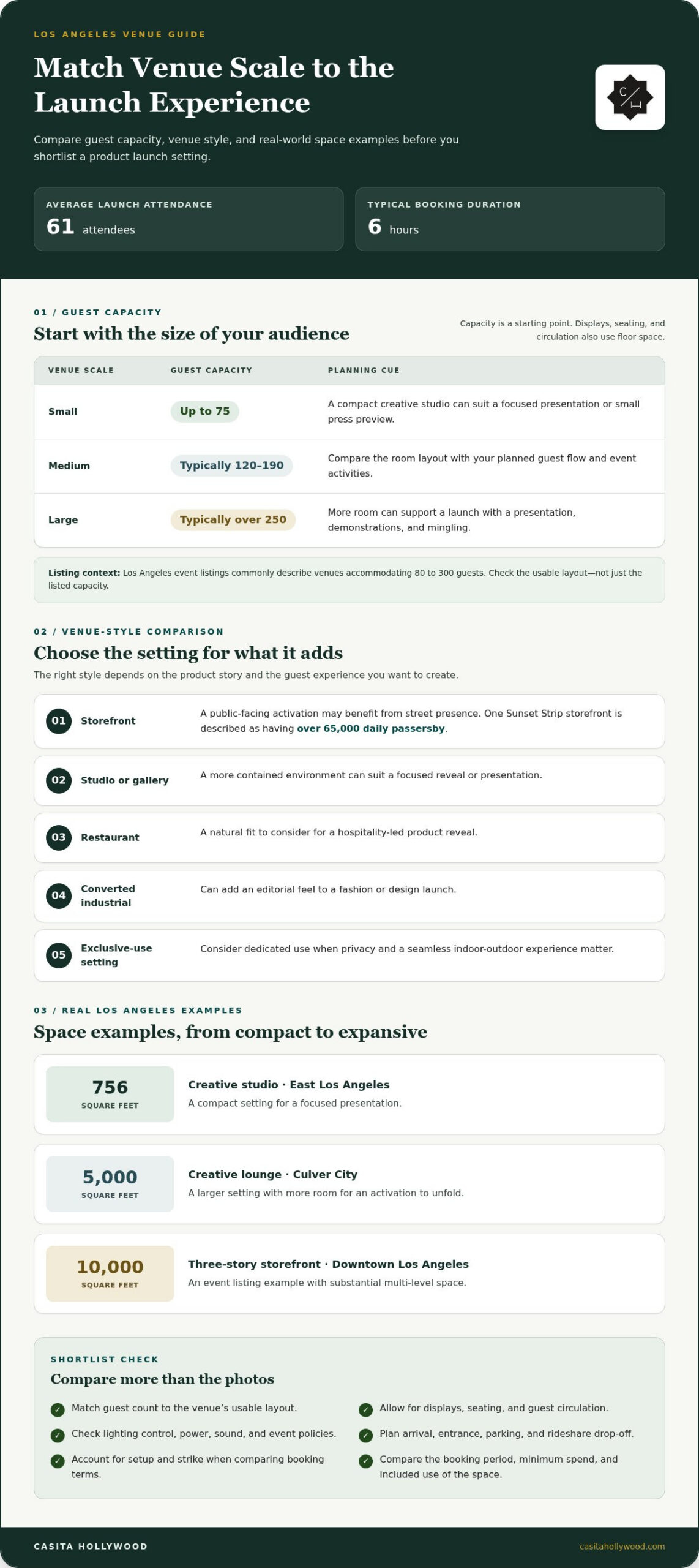
- Use expected attendance to narrow your search: small venues can accommodate up to 75 guests, while large venues typically suit more than 250.
- Look beyond appearance to practical needs such as lighting control, power, arrival flow, crew positions, and parking.
- Account for setup and strike when comparing booking structures, since preparation and strike days may be billed at lower rates than event days.
- Consider an exclusive-use setting when privacy and a seamless indoor-outdoor experience matter to your launch.
How much does a launch event venue cost to rent in Los Angeles?
Launch events average 61 attendees and typically book for six hours, so guest count, location, and booked time all shape the venue choice. A small creative studio and a large event space serve different launch plans.
Venue policies also shape what your event can look and sound like. Discuss signage, filming, sound, alcohol service, and event hours early, and include the relevant requirements in your planning. This is especially important for a fashion reveal that may involve branded backdrops, filming, or evening music.
Los Angeles listings span studios, storefronts, restaurants, converted industrial spaces, rooftops, and historic buildings. A 756-square-foot creative studio in East Los Angeles offers a compact setting for a focused presentation. By contrast, a 5,000-square-foot creative lounge in Culver City gives a larger activation more room to unfold. Downtown Los Angeles also has a three-story, 10,000-square-foot storefront listed for events.
Match the space to the event format, not just the product. An intimate studio may suit a small press preview, while a corporate launch with a presentation, demonstrations, and mingling needs room for each activity. A storefront can put a launch near street activity, a restaurant can suit a hospitality-led reveal, and an industrial setting can add an editorial feel to a fashion or design launch.
Guest capacity offers another useful filter. Small launch venues in Los Angeles accommodate up to 75 guests; medium venues typically hold 120 to 190; large venues typically hold over 250. Event listings also describe Los Angeles venues as commonly accommodating 80 to 300 guests. Treat capacity as a starting point, then consider how displays, seating, and circulation use the floor.
A search across Southern California can broaden your options, but distance affects the guest journey. Nearby listings include Santa Monica, Long Beach, Pasadena, Torrance, Santa Ana, and Inglewood. Keep Los Angeles as your anchor when local access matters, and include neighboring cities when the concept or audience supports it. Compare each product launch venue in Los Angeles by setting, scale, and fit with your event plan, not by photos alone.
For a product launch venue in Los Angeles, weigh the setting against your event format and guest experience. This narrows your options to spaces that serve the launch, not just look impressive.
Los Angeles product launch venue options
For ordinary weeks, product launch venues in Los Angeles are commonly booked three to six months ahead; award season or a major event window may call for 12 or more months. Choose a location that fits both your launch concept and how guests will arrive.
Venue Options and Affordability
Compare venue styles by what they contribute to the experience. A storefront on the Sunset Strip is described as having over 65,000 daily passersby, which may suit a public-facing activation. A studio or gallery can offer a more contained environment for a focused reveal. For an exclusive gathering, consider whether the booking gives your event dedicated use of the space.
Affordability is about more than the rental rate. Compare the booking period, minimum spend, what use of the space includes, and whether setup or strike time affects the total. A smaller room may suit a concise press preview, while a larger venue can accommodate several brand moments. Choose a product launch venue in Los Angeles for the experience you need, not simply the lowest listed rate.
Before shortlisting venues, list the event’s essential activities, such as demonstrations, mingling, and a presentation. Compare each space’s layout and location with those priorities. A good fit can help you avoid paying for unused space while keeping the launch welcoming and well planned.
Parking and Rideshare Access
Plan guest arrival as part of your venue decision. Map the entrance, nearby parking, and a clear rideshare drop-off point. Consider whether guests will arrive together or in waves, and whether product or production equipment also needs to get inside. These details support a smooth arrival without distracting from the first impression.
Before the event, share clear directions that include the venue address, entrance, and parking or drop-off guidance. For a product launch venue in Los Angeles, neighborhood context matters: an urban storefront and a quieter studio may call for different instructions. Make the route to the entrance easy to follow, and consider guest flow when planning check-in.
Compare location, booking terms, layout, and arrival logistics side by side. This makes it easier to identify the option that suits the launch’s purpose and audience, while keeping the budget focused on what guests will experience.
Product launch and brand activation facilities
For a launch, the room should support both the product story and the guest journey. Compare layout, light, sound, and production needs before choosing a setting.
Los Angeles venues differ in what they include. Compare package, catering, and event-planning arrangements separately, since these depend on the venue’s offer. A venue rental alone does not describe the catering or planning support available.
Start with the activation’s practical needs. Look for an open layout, controllable lighting, and power, with clear areas for arrivals, press, content crews, and backstage activity. A demonstration may need space for a screen and clear audience sightlines; a press preview benefits from an uncluttered route between the entrance and product display.
Plan the room in zones. A branded area can introduce the product at arrival, a lounge gives guests a place to pause, and a content area provides a backdrop for photography and video. Keep the screen, cameras, and product display from competing for the same sightline. For hands-on discovery, leave enough open floor for guests to gather without blocking other activities.
Neighborhood character can help shape the creative direction. A studio may suit a controlled presentation, while a rooftop can make the skyline part of the setting. Santa Monica offers a coastal city backdrop, and Culver City’s creative spaces can suit a design-led activation. Choose a district for its atmosphere and access, then build the event layout around it.
Installations should invite interaction without interrupting movement. Place a branded wall, sampling point, or demonstration station where guests can approach, engage, and move on naturally. Keep the arrival path clear, make the main display easy to see, and give press and video teams defined working positions. For a Los Angeles launch, consider lighting and sound control, power for cameras and playback, and crew placement.
A 55,000-square-foot rooftop listing offers a markedly different canvas from a studio, but extra area only helps when the activation uses it purposefully. Sketch the guest path from entry to product reveal, then mark each screen, lounge, and branded installation. This simple plan helps identify layout conflicts before event setup and keeps the product at the heart of the experience.
Hourly, daily, and minimum-spend pricing
Los Angeles venues use different booking structures, including hourly and daily rates or minimum spends. Compare the terms before judging a listing, since the event schedule, setup needs, and included use of the space all affect which structure fits.
Hourly and Daily Rental Rates
These figures describe different booking formats, not interchangeable quotes. Match the rate to the time the event occupies and the production schedule.
Preparation and strike days may be billed at lower rates than event days, which can help when a corporate gathering needs extra installation time. Include lighting setup and removal in the schedule, and compare the full booking period rather than only guest-facing hours.
Minimum Spend and Booking Requirements
A minimum spend is a required event total, while a rental minimum sets the shortest booking period. Read the pricing structure carefully: an hourly rate with a time minimum differs from a spending threshold.
A three-hour minimum, like the Beverly Grove example, means the reservation must meet that duration. A minimum spend instead concerns the required event spending, so check what counts toward it and how it is applied. Compare those terms with the planned gathering and event format before choosing a space.
For each Los Angeles listing, note the rate type, minimum booking period or spend, event hours, and any preparation or strike time. Then consider whether the venue’s commercial setting fits the launch. A short product reveal may suit an hourly booking; a full-day activation with installation and filming may call for daily pricing.
Price alone does not show how a space will support the event. Controllable lighting, for example, may suit a camera-led launch, while an open floor can help guests move between displays. Compare operational fit alongside booking terms, and schedule setup, the main event, and strike.
Before choosing, calculate the booking period from the first setup activity through final removal. Compare that schedule with each venue’s minimums and pricing structure. This helps you assess whether hourly, daily, or minimum-spend terms suit the launch, rather than treating an hourly rate as the complete event cost.
Product launch venues in Los Angeles
Los Angeles launch venues range from compact storefronts to expansive rooftops, and the setting can shape the whole event. Downtown, Hollywood, and Culver City offer different backdrops and styles. Choose based on how guests should experience the product, not just the venue’s most striking photo. A memorable space still needs to work for your event plan.
A multi-purpose Downtown Los Angeles venue is a three-story, 10,000-square-foot storefront. That scale can support distinct moments, such as arrival, product presentation, and conversation, while its storefront format gives the launch an urban-facing character. For a smaller or more focused gathering, compare the layout and usable space rather than assuming that a larger footprint automatically creates a better guest experience.
Scale also affects how guests gather. Small product launch venues in Los Angeles accommodate up to 75 guests; medium venues typically hold between 120 and 190, while large venues typically accommodate over 250. A Culver City listing accommodates up to 150 standing guests, a useful reference for receptions where attendees circulate. Seated presentations need a different layout than standing events, so plan around the activity.
Distinctive architecture can supply a ready-made backdrop. The Ebell of Los Angeles opened in 1927, offering a historic reference point for planners considering heritage settings. At the opposite end of the scale, a Los Angeles rooftop listing spans 55,000 square feet. These examples show how dramatically setting and area can differ, but the right choice depends on the product story and intended atmosphere.
Match the location to the launch’s purpose. A Hollywood setting may suit an entertainment-led reveal, while a Downtown storefront can support a brand seeking an urban presence. A courtyard-style layout can create an intimate focal point when the space allows. Sketch guest movement from entrance to display, then place standing guests, press, and demonstrations without crowding one another.
For a practical shortlist, compare four things: guest capacity, usable layout, visual backdrop, and how the location supports the event format. A 150-person standing reception calls for different circulation than a seated product presentation. A broad rooftop may offer a dramatic setting, while a historic interior can bring character without requiring the event to rely on a skyline view. Let the product remain the visual focus.
When an exclusive setting suits your launch, explore a private event venue as one possible next step. Consider how the full space could support your arrival, reveal, and guest gathering, then weigh that fit against the other venue styles in your shortlist.
Casita Hollywood: Entire Venue
Casita Hollywood offers the Entire Venue for product launches that call for a private, customizable setting. In the heart of Hollywood, indoor and outdoor spaces flow together, creating distinct areas for welcoming guests, presenting a product, and connecting. Exclusive use gives organizers one dedicated environment for the event.
Consider Casita Hollywood when your launch concept calls for shaping the full setting around your brand and guest journey. The indoor and outdoor spaces allow a natural flow between different moments, all within one private venue.
To discuss your product launch plans, contact Casita Hollywood.
Shape the Setting Around Your Launch
The right venue makes your product story clear from arrival to the final conversation. Before committing, sketch the experience you want guests to remember: what they notice first, where they engage with the product, and how the atmosphere supports your brand. This simple exercise can help turn a shortlist into a confident decision.
A product launch venue in Los Angeles should feel intentional, not simply impressive. If you want a private setting that you can shape around your concept, Casita Hollywood offers the Entire Venue. Share your launch idea, guest experience, and preferred atmosphere through the online inquiry form to explore the space for your event.
Contact Casita Hollywood about your launch and take the next step toward a setting that feels distinctly yours.
Frequently Asked Questions
How much does it cost to book product launch locations in Los Angeles?
These are different pricing structures, so compare like with like. Include event time and any setup or strike booking in your estimate.
What are the key factors to consider when choosing a product launch venue in Los Angeles?
For a product launch venue in Los Angeles, start with the guest experience: arrival, product discovery, and the event’s main moment. Assess capacity and layout for your format, whether a seated presentation or standing reception. Consider lighting, sound, power, filming positions, parking, and movement between activity zones. A venue that suits these practical needs can help the concept feel cohesive rather than crowded.
Are there permits and insurance required?
Assess permits and insurance separately. Permit needs depend on the event activity and location, while insurance conditions are set out in the venue agreement. A private product demonstration and a public-facing activation can involve different planning considerations. Describe the format, installations, and how guests will use the space, then account for relevant requirements in your event plan and agreement.
Can the venue support press, filming, and content capture?
Yes. Choose a venue with controllable lighting and sound, power for cameras and playback, and clear positions for photo and video crews. For a filmed product reveal, plan sightlines to the presentation area and screen, and keep guest circulation clear of camera positions. A press preview also benefits from a designated arrival route and uncluttered background, so photographers can capture the product without interrupting the gathering.
What are the best venues in Los Angeles for a product launch?
The best fit depends on the launch format, not a universal ranking. A storefront can suit a street-facing brand activation, a creative studio can support a focused presentation, and a historic setting can add character to a celebration. For an event centered on hospitality, consider a venue with food service facilities. Compare each space’s strengths with the guest journey and production needs.
How much does it cost to rent a product launch venue in Los Angeles?
The booking total depends on the pricing structure and time reserved. Compare the event schedule with the venue’s minimum booking terms, including time needed for installation and removal.
How do LA hotels, event spaces, galleries, rooftops, and studios compare for product launches?
Hotels can suit launches that need a polished, hospitality-led setting, while galleries foreground artwork and visual presentation. Rooftops make the skyline part of the atmosphere; studios offer a more controlled creative environment. Event spaces vary in layout and character. Compare how each option supports the product display, audience movement, and production setup, then choose the setting that best serves the event’s central experience.
What are the best neighborhoods in Los Angeles for a product launch venue?
Hollywood suits a launch seeking a central, entertainment-linked setting; Downtown offers storefront and urban event-space options. Culver City has creative venue listings, while Santa Monica provides a coastal city backdrop. East Los Angeles also has studio spaces. Choose a neighborhood based on your audience’s arrival plans and desired brand atmosphere, then compare specific layouts and event needs within that area.