


An event venue contract should put the practical terms in writing: payment dates and amounts, cancellation and refund rules, insurance responsibilities, included services, and access times. Understanding event venue contracts means reviewing those details against the event you’re planning, so expectations are clear before the celebration begins.
It’s easy to be drawn to the light, layout, and atmosphere of a venue; the agreement is what helps turn that vision into a workable plan. This guide shows you how to review deposits and payment schedules, understand cancellation terms and vendor insurance, identify what the venue price includes, and create an event space rental agreement that records the essential details. From load-in and overtime to food-and-beverage commitments, you’ll know which terms shape your budget and how the event will unfold, with fewer unwelcome surprises along the way.
Key Takeaways
- Map each deposit, payment date, refund condition, and cancellation penalty so you can see the financial commitments before signing.
- Clarify who is responsible for event-related damage and disputes, and what liability insurance vendors must carry.
- List the equipment, staffing, and services covered by the venue price to distinguish included provisions from potential add-ons.
- Build the agreement around event logistics, including access and exit times, food-and-beverage commitments, guest minimums, and event-specific requirements.
1. Deposits, payment schedules, refunds, and cancellation policies
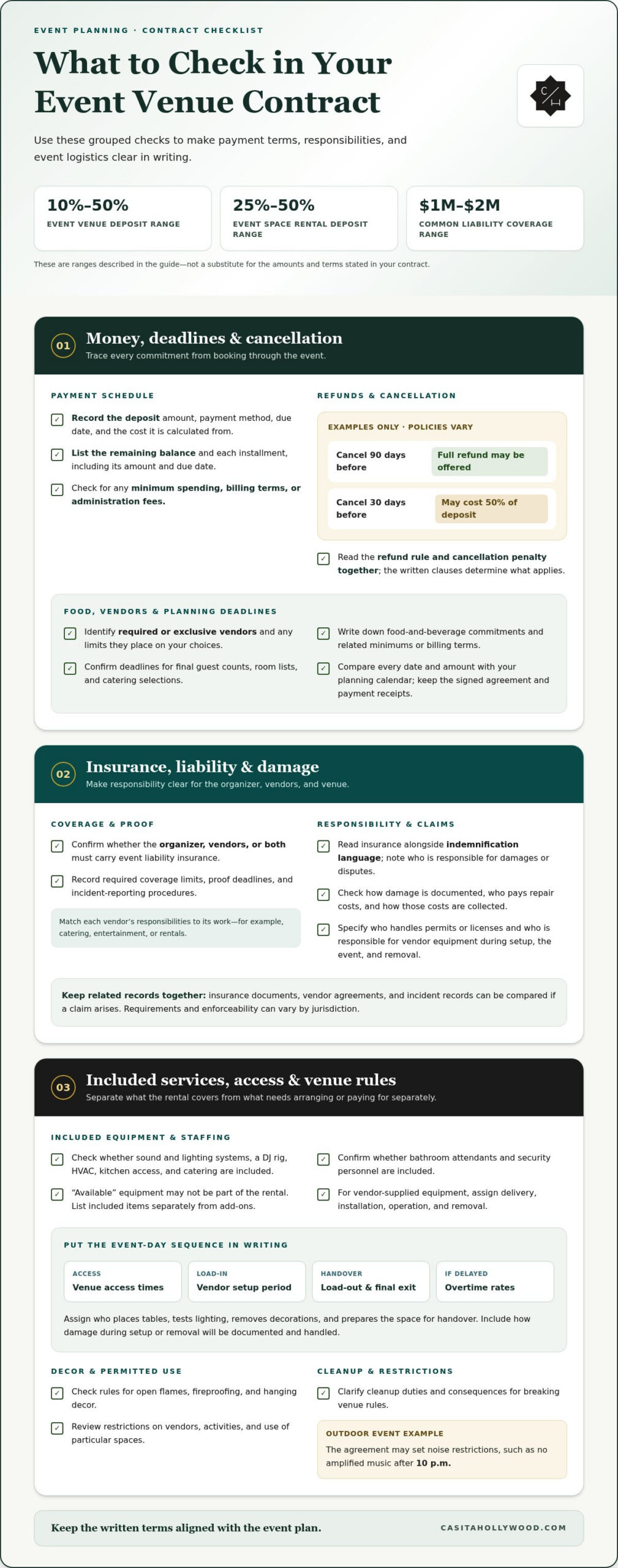
Start with the amount due to reserve the event space. Event venue deposits usually range from 10% to 50% of the total cost; event space rental deposits commonly range from 25% to 50% of the total rental cost. These are different market ranges, so the contract’s stated deposit and calculation base matter. Record the deposit amount, payment method, due date, remaining balance, and each installment in one schedule.
Next, trace the payment terms from booking through the event. The contract should state deposit and final-payment dates, payment amounts, refund rules, cancellation deadlines, penalties, and administration fees. Some venues may offer a full refund for cancellation 90 days before an event, while cancellation 30 days before may cost 50% of the deposit. Treat those as examples, not universal policies; the written cancellation clause determines the applicable terms.
Food, beverage, and outside-vendor rules affect both costs and choices. The agreement should identify required vendors, any food-and-beverage commitments, and deadlines for final guest counts, room lists, and catering selections. Exclusive vendors can limit your options and add unexpected costs, so identify those conditions alongside any minimum spending or billing terms. A deadline matters financially: missing it may affect the final amount due or the services arranged for your event.
Key clauses include the payment schedule, cancellation and refund policies, damage responsibility, vendor requirements, and deadlines for final payment, room lists, and catering. Read them together; a deposit may be nonrefundable under one clause, while a separate cancellation clause sets penalties by timing. For clearer understanding of event venue contracts, compare each date and amount with your planning calendar, then save the signed agreement and payment receipts. This simple step creates a clear record if a payment, refund, or cancellation is later disputed.
2. Vendor insurance and liability requirements
Event venues commonly require event liability insurance with coverage ranging from $1 million to $2 million. The contract should explain whether the organizer, vendors, or both must carry coverage, and when proof is due. Match each vendor’s responsibilities to its work: a caterer, entertainer, and rental company may create different risks within the same event space.
Read insurance clauses alongside indemnification language, which clarifies who is legally responsible for damages or disputes arising from the event. Look for wording that assigns responsibility to the party whose actions caused a loss, and note terms that appear to shift broad liability onto you. Before signing, record any required coverage limits, proof deadlines, and incident-reporting procedures.
Do event venue contract rules vary by state or local law? Yes. Requirements and contract enforceability can vary by jurisdiction. In Los Angeles, a lawyer reviewing the agreement can assess whether its terms comply with applicable laws and regulations.
Clarify who handles any permits or licenses relevant to the event, and whether restrictions apply to vendors, activities, or use of particular spaces. Putting these responsibilities in the contract prevents assumptions. For example, if a vendor brings equipment, specify who is responsible for damage during setup, the event, and removal.
Also read the provisions for cleaning, property damage, and claims. The agreement should explain how damage is documented, who pays repair costs, and how those costs are collected. Keep insurance documents, vendor agreements, and incident records together, so the responsibilities in each document can be compared if a claim arises. As you consider your event plans, explore the venue’s event setting alongside these contract details.
3. Equipment and services included in the venue price
The agreement should identify which services and equipment the rental covers. Check whether sound and lighting systems, a DJ rig, HVAC, kitchen access, and catering are included. “Equipment available” doesn’t necessarily mean it’s part of the agreed rental. Make a written list that separates included items from anything arranged or paid for separately, and specify whether operating support is included.
Clarify staffing in the same way. The contract should say whether bathroom attendants and security personnel are included and describe any related responsibilities. If vendors must supply additional equipment, record who delivers, installs, operates, and removes it. A clear division of tasks helps prevent unexpected charges, missed setup steps, and disputes over responsibility.
Setup and takedown terms shape the event schedule. Put venue access times, vendor load-in and load-out periods, final exit time, and any overtime rates in writing. Assign each task: who places tables, tests lighting, removes decorations, and prepares the space for handover? The contract should also explain how damage during setup or removal is documented and handled.
Decor rules can affect a design plan before vendors arrive. The agreement should address open flames, fireproofing, and hanging decor, so planners can choose suitable materials and installation methods. For an outdoor event, include applicable noise restrictions, such as a ban on amplified music after 10 p.m. Review these clauses with the vendor plan before signing. Check that the agreement clearly identifies included services, permitted decor, cleanup duties, and consequences for breaking restrictions. That careful comparison helps align the event’s visual details with the venue’s terms.
4. How to Create an Event Space Rental Agreement?
Start by naming the parties, event type, date, location, and permitted activities. A wedding reception, corporate meeting, or private celebration may need different provisions for guests, vendors, and use of the space. State whether the rental covers exclusive use or only specified areas. For a partial-space rental, outline shared areas, access boundaries, and who manages transitions between event areas.
What should an event venue contract include? Set out rental fees, payment obligations, access and final-out times, load-in and load-out periods, included services, damage responsibility, cancellation terms, and signature requirements. Add the minimum guest count the organizer must pay for, plus any food-and-beverage spending minimum or per-person and bar overage clauses. Write each obligation clearly, so both parties can identify who is responsible.
For timing, state the exact access period and any overtime rate. Identify deadlines for guest counts and catering commitments, along with setup and cleanup responsibilities. A force majeure clause should address events such as natural disasters or government restrictions that make performance impossible. It should explain how notice is given and what happens next, such as rescheduling or waiving penalties.
How can you negotiate before signing? Mark unclear terms and propose precise edits to timing, included services, guest minimums, or cancellation provisions. Record agreed changes in the contract, not only in messages or conversation. Red flags include vague charges, conflicting clauses, unclear space boundaries, and one-sided damage terms. Read the final version line by line before signing, even if a deadline feels close.
Finally, match the agreement to the event’s real footprint. A full-property rental and a defined-room rental create different access expectations; record which areas vendors and guests may use. To explore an event setting for your plans, view the venue space.
Casita Hollywood: Entire Venue
Casita Hollywood offers the Entire Venue for events that call for a private, adaptable setting. With exclusive use of the property, organizers can shape the gathering across its seamlessly connected indoor and outdoor spaces, rather than planning around separate bookings. It can suit event hosts who value a dedicated environment and want the full property for their occasion.
When reviewing the agreement, make the exclusive-use arrangement specific: identify the included spaces, event access period, vendor responsibilities, and services covered by the rental. Casita Hollywood offers a cocktail bar, full commercial kitchen for caterer use, private green room, outdoor patio and lounge, and outdoor fireplace. A written outline helps align the venue with your plans.
To explore the Entire Venue for your event, visit casitahollywood.com.
Make the Space Part of the Plan
A thoughtful agreement can do more than prevent misunderstandings. It can keep your event’s atmosphere, logistics, and responsibilities aligned. Before committing, picture the experience you want guests to have, then choose a setting and written terms that support it. Understanding event venue contracts means treating the document not as a final formality, but as a planning tool that brings the occasion into focus.
For hosts seeking exclusive use of a property in Los Angeles, Casita Hollywood offers the Entire Venue, with indoor and outdoor spaces for a private, adaptable gathering. It suits events where a dedicated setting is central to the experience. Consider the spaces and services your plans require, then put the details in writing from the start.
Contact Casita Hollywood today to explore the Entire Venue for your event.
Frequently Asked Questions
How to Create an Event Space Rental Agreement?
Start with the event’s purpose, date, and exact spaces being used, then put each planning decision into a written term. A wedding reception and a corporate meeting, for example, may need different guest-access arrangements. Have both parties review the draft, resolve unclear wording, and keep the signed version with your planning records. The agreement then serves as a practical reference during preparation.
What is an Event Venue Contract Review?
An event venue contract review is a close examination of the agreement before signing. It can identify unclear obligations, conflicting language, or terms that don’t match the event plan. In Los Angeles, a lawyer reviewing the document can assess whether it complies with applicable laws and regulations. A useful review connects each clause to a practical decision, such as who coordinates vendors or handles a schedule change.
How do event venue rental fees, deposits, and payment schedules work?
The agreement should set out rental fees, payment dates, and how each payment applies to the total. Compare installment amounts with the stated rental fee, and note whether a separate charge is refundable or applied toward the balance. Keep payment records with the contract to track amounts paid and remaining obligations.
What are typical event venue cancellation and refund policies?
Cancellation and refund policies explain how the venue handles notice, retained payments, refunds, and administrative charges. The outcome depends on the written terms and when notice is received. Read the cancellation process alongside any rescheduling clause, since postponing an event may have different consequences from cancelling it. Keep a copy of any notice and follow the contract’s stated delivery method.
Who is responsible for event permits, security, cleanup, and damage?
Assign each task to a responsible party rather than leaving it to assumption. Name who arranges permits, provides security, and completes cleanup, then state who documents damage and handles repair costs. A responsibility chart attached to the agreement can clarify duties for the organizer, venue, and vendors. Record the space’s condition before and after the event to support a shared account.
What insurance and liability coverage do event venues require?
Event venues may require event liability insurance, while the agreement states who must provide proof and which activities the coverage applies to. Read those terms with the indemnification clause, which clarifies responsibility for event-related damages or disputes. A vendor bringing equipment should understand its responsibilities in relation to the organizer’s. Keep insurance documents with the signed agreement so the terms are easy to find.